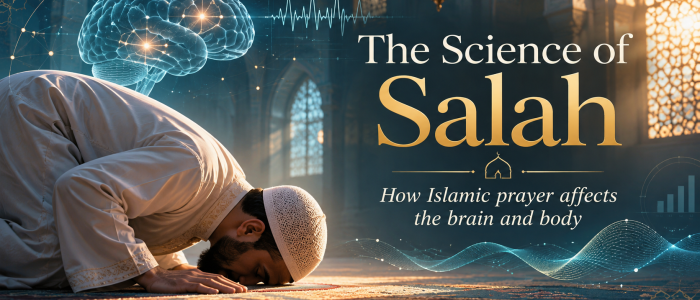
Five times a day, Muslims step away from the demands of everyday life to engage in Salah, a practice combining focused attention, Qur'anic recitation, rhythmic movement, and conscious surrender to God. What many people outside Islam don't realize is that researchers have begun examining what actually happens to the brain and body during these prayers. Their findings suggest that Salah is not simply a religious ritual. It is a remarkably integrated practice involving neurological activity, autonomic nervous system regulation, physical movement, and sustained attention.
In a 2014 study published in the Journal of Alternative and Complementary Medicine, researchers at the University of Malaya monitored the brain activity and heart rate variability of 30 Muslim men performing Salah. They discovered significant increases in alpha brainwave activity, particularly in the parietal and occipital regions. Alpha waves are commonly associated with relaxed alertness, reduced mental tension, and states of calm awareness. At the same time, researchers observed increased activity in the parasympathetic nervous system, the part of the autonomic nervous system involved in rest, recovery, and physiological regulation. These findings suggest that Salah can encourage the body to shift away from heightened stress responses toward a calmer physiological state.
A separate 2016 study examined gamma brainwave activity during Salah. Researchers compared participants performing the complete prayer, including Qur'anic recitation, with participants performing the same physical movements without recitation. They found significantly greater gamma activity during actual Salah, particularly in frontal and parietal brain regions. Gamma activity is associated with cognitive processing and attention, suggesting that the combination of recitation and movement engages the brain differently from physical movement alone. This is particularly interesting because Salah involves both relaxation and active concentration. The worshipper is not merely attempting to empty the mind but directing attention toward remembrance of God.
The physical dimensions of Salah are equally fascinating. Standing, bowing, prostrating, and sitting engage multiple muscle groups and joints throughout the body. A 2019 scientific review published in the Pakistan Journal of Medical Sciences examined Salah as a form of therapeutic exercise, discussing its potential contributions to muscle activation, balance, flexibility, and physical function. Unlike conventional exercise, however, the movements of Salah are integrated into acts of worship and repeated throughout the day. This creates regular opportunities for gentle movement, although the available research does not establish that Salah can replace conventional exercise or medical treatment.
Perhaps the most interesting dimension is the way Salah structures daily life. Instead of allowing the demands of work, consumption, entertainment, anxiety, and personal ambition to occupy every waking moment, Muslims are called to interrupt that momentum five times a day. The practice repeatedly redirects attention away from the endless demands of the ego and toward something understood to be infinitely greater than the self. From a psychological perspective, these recurring interruptions offer opportunities to cultivate attention, self-awareness, emotional regulation, and intentional behavior. Research into Salah's long-term psychological effects remains limited, but its structure makes it an especially interesting subject for further study.
And then there is sujūd, the act of prostration. The worshipper places the forehead on the ground in an expression of complete humility before God. Research examining the postures of Salah has identified changes in alpha brainwave activity during prostration, suggesting that the position itself may contribute to a relaxation response. But for Muslims, sujūd carries a significance that no EEG can measure. In Sahih Muslim 482, the Prophet Muhammad ﷺ taught that a servant is nearest to his Lord while prostrating. The position of greatest physical humility becomes an occasion for extraordinary spiritual intimacy.
The research is still developing. Many studies involve small groups of participants, and scientists have not established all the long-term health effects of performing Salah five times daily. Nevertheless, the existing evidence provides a fascinating glimpse into a practice that engages the nervous system, attention, and body in a coordinated rhythm.
For nearly fourteen centuries, Muslims have practiced Salah not because scientists discovered alpha waves or measured heart rate variability, but because prayer is central to their relationship with Allah. The neurological and physiological findings do not explain away its spiritual significance. They reveal that something meaningful is also happening within the human organism during worship.
And perhaps that is what makes Salah so extraordinary. It is not simply a technique for relaxation, a series of stretches, or an exercise in mindfulness. It is a complete act of worship that brings the body, attention, speech, intention, and heart into the remembrance of God. Five times a day, the believer steps out of a world constantly demanding more and returns to the One who needs nothing.
The science helps us understand what happens during Salah. The spiritual tradition helps us understand why Muslims pray.
Scientific references
Doufesh et al. (2014), Effect of Muslim Prayer (Salat) on α Electroencephalography and Its Relationship with Autonomic Nervous System Activity. PubMed
Doufesh et al. (2016), Effects of Muslims Praying (Salat) on EEG Gamma Activity. PubMed
Salat (Muslim Prayer) as a Therapeutic Exercise (2019). PubMed
The Neuroscience of Religious and Spiritual Practices: A Systematic Review of Neurotheological Evidence (2026). Full review